Following yesterday’s missive I also wanted to mention that I finally started Rebecca Solnit’s book, Wanderlust. It’s one of those titles that’s been on my shelf for ages and an obvious one to have procured given my interest in walking as a “post-studio” (i.e. non-material yet creative/generative) performative practice. For some reason I never got to it before now, though. And I’m really grateful that I waited. Had I read it prior to this project I may have missed this beautiful overlap – a gently revolutionary Solnit-ian gem:
“[T]hinking is generally thought of as doing nothing in a production-oriented culture, and doing nothing is hard to do. It’s best done by disguising it as doing something, and the something closest to doing nothing is walking.”
One of the (many) reasons why this project of Doing Nothing is so daunting to me is in fact beyond my perceived obligation of adhering to an insidious set of principles I have unwittingly ascribed to for much of my “productive” life – namely the “Protestant Work Ethic.” (I’m not even Protestant). It’s not just about the “feeling-guilty-because-I’m-not-working-enough” factor. The guilt surfaces, but then eventually subsides. No, it’s something more debilitating than that. An irresistible cycle of other sensations is activated – feeling ungrounded, unsettled, confused – which is then capped off by the kicker: I become depressed. And the longer the time I have to disconnect from the rest of the world (i.e: my computer) the more likely that inevitable depression descends upon me. I’ve previously considered the connection between being (or rather keeping) busy and holding myself together. And this is a known phenomenon too, I realize I’m probably not telling you something you don’t already know. But having the month to sit with this, and let it sit with me, was not the easiest. Once my body’s healing process was underway, I had lots of time to be… with myself, my thoughts and my anxieties. Not being able to really take walks, or do much in the way of physical exertion; not being able to read anything too dense; not really having the concentration to sit and write… meant I had a lot of time to think. Or not think. To just blank out. And feel sad.
Admittedly there were moments of bliss. How joyful to be quiet and calm. To not be on a schedule. To not have to produce! But it often felt tenuous. That adolescent existential stuff that I recall so vividly, those annoying questions that plagued me, seemed to resurface: “What’s the point? What’s my purpose? Is that all there is?” And as one day started melting into another…each day feeling exactly the same, filled with… nothing (I have a history of depression which began at around the age of 14 while reading Albert Camus no less)… I was just concerned that it might spiral out and I along with it…
Which I didn’t. I credit my chanting meditation practice for keeping me on track. But even that felt tenuous at times too. In the realm of Depression, Lethargy is only ever a few steps away…
One book I did manage to read – as recommended to me by fellow artists from DARE-DARE – had some insightful reflections on the connection between spacing out and being down. According to Andrew Smart, a human factors research scientist, apparently when we engage in idleness, all kinds of deeper recesses in the brain light up: “This ‘resting-state network’ (RSN) or ‘default-mode network (DMN),’ as it is called … comes alive when we are not doing anything.” (Autopilot, p.19).
Because these areas of the brain are concerned with memory and the unconscious – where the things we would rather not encounter generally stay buried:
“What comes into your consciousness when you are idle can often be reports from the depths of your unconscious self – and this information may not always be pleasant. Nonetheless, your brain is likely bringing it to your attention for a good reason.” (Autopilot, p. 3).
So I think he’s on to something when he asserts (from the same page above):
“Psychological research has shown that humans, especially American humans, tend to dread idleness. … Given the slightest or even specious reason to do something, people will become busy. People with too much time on their hands tend to become unhappy or bored. Yet … being idle may be the only real path toward self-knowledge.”
Today, August 8, I am officially “back to work.” Be it that I work from home and that it’s still summer season for the cultural sector I don’t have a ton of stuff to get back to (for which I am really grateful). But I feel the quiet rumblings of a busy fall soon upon me.
I know I wrote in my previous post that I would take the two weeks for convalescence and then follow that by just taking time off. That timeline came from the hospital who claimed that most people go back to work after two weeks. Um… good thing I didn’t have a job to go back to because almost five weeks later and I’m still not functioning at full speed. Yes, I can do the normal things we (modern) humans do: answer an email, make a salad, do an errand, have a conversation, take a walk (albeit, still a fairly short one) but my concentration is pretty limited and my brain is doing funny things. And my body… is still feeling the strange pulling and re-settling sensations that I guess come from things having been poked around in there (and removed). I hear the anesthetic can take a while to fully leave your system too.
So that got me thinking about the pressure we are so often under to be on it. All the time. To bounce back. And in no time at all. It’s taking me way more time than that. I’m just really glad I have that time to take.
This July 5, 2016 I will be undergoing laparoscopic surgery. It means that I’ll be forced to do nothing for one to two weeks afterward to allow for convalescence. Doing a lot of nothing while my body does a lot of something: healing itself. It got me thinking: what if I take the two weeks and turn it into a whole month? As in, take the month of July off. As in, vacation responder on my email account and check out from Facebook. As in, stop working. (The prospect simultaneously thrills and terrifies me).
But it’s decided. I am taking that time to heal. And have a break.
Good timing, what with this Nothing project going on and all.
The reason why I am sharing this with you is because I have a proposition:
While I spend the month healing from this operation I invite you to take an hour (or several) once a week (or every day) to sit with something that you feel you would like to heal too (physical, emotional, etc.). Reflect on it, write, sing, dance, draw, walk, swim, meditate… or just hold it lightly as a gentle intention and space out. Any formula you wish; as often or as infrequently as suits your needs; it’s yours and your rules to play with.
You could also just take that hour and do nothing.
What are you wishing to start – or continue – healing from this month?
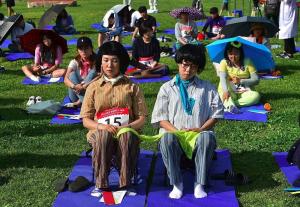
Contestants at this year’s Space Out Competition. Photo by Jung Yeon-Je/AFP/Getty Imag
This one kinda went viral but I can’t resist (re)posting it here (it was sent to me by several friends/colleagues after I announced the Space-Out Solstice. Funny coincidence of timing!) :
• Doing Nothing Has Become a Sport in South Korea
“A few weeks ago, on a Sunday afternoon, about 70 people gathered at Ichon Hangang Park in Seoul, South Korea, to do absolutely nothing. There was not a smartphone in sight, no texting or taking selfies, and no one rushing to get anywhere.
The crowd was taking part in South Korea’s annual Space Out Competition, a contest to see who can stare off into space the longest without losing focus. WoopsYang, the visual artist who created the event in 2014, said it’s designed to highlight how much people have been overworking their brains and how much they stand to gain by taking a break…”
“The agitated pace of capitalism creates a tonic state of dis-ease and dis-connec- tion felt in the (more-than-human) body and, as a result, a pathology of place imprints itself onto/into bodies as a re-enactment or performance of a dis-eased environment (or place). How can we return new life to our dulled senses? What are the pathways to reconnect? As an exploration of an embodied cellular understanding of place/loss of place through (eco)somatic practices, slow knowledge, and relational embodied ethics, this paper/presentation will speak to/with/through a site-responsive, performance-based research project in progress by Sally Morgan…”
And so: the workshop (Boundaries of the Body) wrapped up on Monday eve, with a blissed-out kinda vibe and a real desire to, once again, not make anything (see post-apple blossoms below). There was a thought that we could do an action (or non-action) but what we really wanted was to just hang out. And eat. Plus our timing was such that an activity was already going on right next to us (monthly public dance event at Beaver Lake). And so: a spontaneous picnic on the concrete in front of the space-age ice-skating chalet unfolded beside the folk-dance gathering before a rainstorm then followed by an epic twilight walk with a surprise glimpse of an incredible strawberry moon.
It was pretty close to perfect.
And so: apologies if you came out and didn’t find us! I hope in that case you found/made/felt your own brand of special solstice magic! You were definitely with us in spirit!
The next non-event is scheduled to take place on June 20, in honour of the Summer Solstice. Participants from the Boundaries of the Body intensive performance art workshop (Gabrielle Desrosiers, Maro Goranitis, Koby Rogers Hall, Mathilde Rohr, and Tim Schauer) will lead this non-active action starting at 8pm. All are invited to attend. Please come with Open Hearts and, if possible, No Expectations. Not sure exactly what will happen, but I think it will be Real.
Where: In front of the Chalet of the Lac des Castors – Mont-Royal
When: June 20, 2016 starting at 8pm
Even the Banff Centre is thinking about Doing Nothing… I just learned about a new retreat they are offering this fall: The Art of Stillness Residency.
“This interdisciplinary residency provides writers, visual artists, dancers and musicians the opportunity to work with expert faculty whose work explores stillness and its relationship to the creative process, while also providing the time to slow down, reclaim mind space and hone their practice…
…In this residency, participants will engage across disciplines on what this increased speed of life means for practicing artists and what value we can gain in slowing down.”
Sounds pretty sweet, hey? The deadline is June 22.
Since I’ve started this project, I’ve had a lot of Nothing on my radar. Lately floating my way, here are some links to writing, thinking and acting upon Nothing (through texts and projects that treat notions of Leisure, Stillness, Productivity (or lack thereof), La dérive (wandering), and Le flânerie (floating aimlessly) that I would like to share. I’ll post others as they too cross my path.
• Nothing to see here: the artist giving gallery staff a month off work
“Maria Eichhorn’s 5 weeks, 25 days, 175 hours presents visitors with a closed and unoccupied gallery. The staff, including gallery director Polly Staple, will be on free time and full pay until 29 May. Phones will not be answered, emails to gallery addresses will be deleted, except for a dedicated account that will be checked every Wednesday. There’s nothing to see, but lots to think about. Who is paying for this time? What does this withdrawal from work and suspension of the gallery’s activities mean? It is not a strike or boycott, nor a protest in any obvious way…”
“La notion de temps libre est au cœur des explorations entreprises par Sylvie Tourangeau dans le contexte d’une résidence débutée à l’automne 2013 et échelonnée jusqu’en mai 2015. Alternant des actions in situ où elle agit seule dans des espaces associés au silence, à des mises en situation in socius où elle s’ouvre à une interaction avec des inconnus, le processus a pour but d’opérer une canalisation symbolique du temps libre à travers les rencontres, les gestes, les récits, les objets et les images qui en émergent.
…À mesure qu’évolue son projet, un impératif se dessine et l’habite. Il porte le poids d’une mission quasi improbable: infléchir sa posture d’artiste en la soumettant à la rigueur hygiénique du temps libre. Mais, qu’est-ce qu’un temps authentiquement libre ?…”
“It is rare to meet a person these days who has superiour skills in leisure. How often do you hear someone say: “By gosh, that person has a remarkable leisure ethic?” A good worker, on the other hand, is something that we constantly hear praised.
…Leisure is not what happens by simple virtue of not working. Leisure is not rest, inaction and passivity, quite the contrary. To engage in purposeful purposeless, and to do it well, is a skill that takes time and practice…”
“…La figure du flâneur, depuis Beaudelaire, occupe une part importante de l’imaginaire à laquelle on associe souvent celle de l’artiste. De rêveur à activiste, le flânage peut-être incarné selon une multitudes d’intentions, ce qui en fait un terreau très fertile pour les artistes comme Sophie Calle, Daniel Buren, Vito Acconci, Janet Cardiff et Francis Alys, pour ne nommer que ceux-ci.
Souvent perçue comme péjorative (Flânage interdit!), cette activité peut en effet s’investir d’une intention contestataire si on la compare à la constante productivité que l’on exige de l’individu contemporain…”
“Entre les divers procédés situationnistes, la dérive se définit comme une technique du passage hâtif à travers des ambiances variées. Le concept de dérive est indissolublement lié à la reconnaissance d’effets de nature psychogéographique, et à l’affirmation d’un comportement ludique-constructif, ce qui l’oppose en tous points aux notions classiques de voyage et de promenade…”
Isn’t it ironic that right after doing the first set of (non)actions, I managed to land a new job. Don’t get me wrong, I’m grateful, but wow, you know how new work means major learning curve? I haven’t had a chance to Do Nothing since right after the last (first!) couple of encounters. Not complaining, just… remarking on this interesting turn of events. So what does this mean, how does all this new Something turn into a new Nothing? Not sure I have the answer just yet but I do know this: all the Nothing that is coming will be even more precious because of all the Something now exponentially entering into my life. PS: the new job is only for the summer so another shift will come again as of fall…






 The Sanctimonious Sect of Nothing Is Sacred