Post-Experience Thoughts: Sarah Harwood on Doing Nothing

I first met Sarah when I started to go for Feldenkrais sessions in August 2015. I was there primarily because of persistent back pain, and was curious about this method, having tried a number of other treatments.

…Personal problems aside, it quickly became clear to me when I began my lessons (as they are often referred to with this practice) how many intersecting points there are between this somatic method and many of the notions that are forefront in my current performance art research. The enactment of the micro-event, the importance of what transpires in the invisible, the emergence of a tangible, liminal experience… these three components could just as equally describe (one form of) performance research as they could Feldenkrais.

At some point early on during this trajectory, I was also gearing up (or down, as it were!) toward the Doing Nothing project. Of course, arriving at the particular juncture in my work where I had – stripping away pretty much all artifice and creating increasingly imperceptible “actions” – I saw how this new direction I was taking (or really, a deepening of a direction that my work was basically moving in) was also being mirrored in my newly acquired intellectual & embodied knowledge of Feldenkrais. I felt as though I was experiencing Doing Nothing on a whole other plane.

Which is what inspired me to invite Sarah to give a presentation in the form of a lesson. I wanted to hear her speak to these ideas, but we both agreed: talking about music is like dancing about architecture. In other words, the proof is in the pudding and the best way to really discover Feldenkrais is to just…experience it!

And to help frame the experience through the lens of Doing Nothing, to see if we could create these parallels in real time through the actual lesson, here is what I proposed to Sarah:

“I am interested in how the micro-event can/does connect to states of cognitive/physical awareness & transformation; how in an apparent stillness (or very very subtle movement) taking place in our body/mind, so much is actually going on! … And so I am wondering: What is happening in the body when seemingly not a whole lot is (visibly) taking place? Where is this transformation occurring? How is the body integrating these changes?

I am wishing to explore how it is that when we engage in this very subtle listening and engage in these micro movements, we are also making space for a deeper listening to occur. So it continues along and creates a kind of cycle: once we start to listen more deeply, which potentially leaves/makes more room for heightened awareness, we are then prone to increasingly notice these subtle (and sometimes not so subtle) shifts in our bodies – increasingly recognizing the fact that lots is happening. We then make (even more) room, leave room, create room (space/time in our bodies & minds) through these subtle processes for even more shifts to exist, to emerge, to take up this space (in our consciousness, in our bodies)… the micro, and seemingly invisible, event manifests in visible (and visibly felt) ways.

All the while… it might look (and even at first feel) as though we aren’t really doing anything… ie: a kind of doing nothing… and yet, so much is actually happening.”

Sarah responded:

“The idea of making space resonates with me very deeply in a literal and figurative way. That’s how I feel when I take care to feel in a “feldy” way. There’s a tangible yet mysterious sense of expansiveness and potential that opens up especially if we’ve been able to not make any extra effort with the movement. We get the most profound results when we emphasize listening to ourselves authentically over trying to reach a goal. If we try too hard in a Feldenkrais session, we can end up frustrated, sore, and defeated. If we can engage with what is actually happening in the moment with care and respect, suddenly that space we are talking about presents itself.”

…Post-lesson, we had a discussion which came back to these ideas as a starting point into all the myriad parallels & resonances. We were reminded by Sarah, for example, how rest is implicit – and absolutely crucial – in the practice, how when we do learn something new, it is strongly recommended to be still, and let the body integrate this new information. Very similar line of thought to that which neuroscientists studying the brain in states of inactivity have also determined (Andrew Smart, Autopilot).

But then, the unexpected and marvelous revelation of this lesson surfaced via a remark from one of the participants. Because I come to this practice nonetheless with a subjective perspective, a set of ideas that I have been mulling over for several months, and so also possibly a set of assumptions, this observation stirred me. While on the one hand it is desirable to feel a beautiful sense of abandon, of peaceful calm and relaxation, not everyone does encounter these particular sensations. However relaxation isn’t necessarily the goal. While rest is implicit and the incredibly subtle movements can seem like our body is barely doing anything, the actual aim, as Sarah commented, is “to use our bodies in the most effective way possible.” This means with the least amount of effort possible. Little effort because the body is learning bit by little bit how to be increasingly efficient. The mind then follows and as clarity sets in, so does a greater sense of self-awareness, and alertness. At first that can feel like you’re “cheating” (what’s going on, shouldn’t I feel like I “did something?”) but that is part of the startling result, coming back to what Sarah said earlier: “If we try to hard, we end up sore and defeated…” Effortless effort, as founder Moshe Feldenkrais called it, is the goal. And how fascinating that this phenomenon is, as it happens, also the main tenet of Wu wei*, an important concept in Taoism that literally means non-action or non-doing… ” (which I’m just reading about now – as I write this – on Wikipedia). Yet another layer of linking concepts…

…Clearly, I’ll be saying more on that front soon!! But I’ll leave it here for now.

*With thanks to Robert Luzar for placing this last notion onto my radar, mere moments before the class. Talk about impeccable timing.

Moment. Of. Nothing.

As part of B-312’s annual collective fundraising exhibition, POUR L’ART, I will be proposing a performative experience. Moment. Of. Nothing. (Moment. De. Rien.) invites potential art-buyers to choose a moment of nothing among three possible options. One, two or three of the three performative experiences can be purchased, the resulting “product” being an accompanied moment together, out in the world, doing nothing. A walk, an interval in sitting, a pause while staring off into space are all on offer…

POUR L’ART, exposition bénéfice
Galerie B-312
372, Ste-Catherine, O, suite 403

Du 22 avril au 13 mai, 2017
vernissage le 22 avril, 2017 à 14h

– read more about the exhibition here –

Talking About Nothing With… Parlons de rien avec… Sarah Harwood (Montreal)

Public Forum About Nothing Presents: Talking About Nothing With…

Sarah Harwood
April 21, 2017 from 2 to 4pm

As part of the yearlong project, The Sanctimonious Sect of Nothing Is Sacred, I am inviting artists, researchers, thinkers, and practitioners of various disciplines – both within and outside of the arts – to present their reflections in an open format around the question of Doing Nothing.

The fourth in the series is a hands-on lesson, followed by an open discussion, with Feldenkrais Method Practitioner, Sarah Harwood.

Feldenkrais is a form of somatic education that uses gentle movement and directed attention to improve movement and enhance human functioning. Through this Method, you can increase your ease and range of motion, improve your flexibility and coordination, and rediscover your innate capacity for graceful, efficient movement. These improvements will often generalize to enhance functioning in other aspects of your life.

Sarah writes:
“By moving slowly and deliberately in each class using everyday actions like looking up, reaching, turning, or bending as inspiration, we are given the opportunity to learn how we use ourselves. We experience how different parts of ourselves relate to each other and we can use this knowledge to inform a variety of movement options and thinking patterns that may have previously been unavailable to us. People of all fitness levels, abilities, sizes and genders are welcome to attend. The classes are verbally guided, and hands-on help is available for those who request it. Classes are usually conducted either on mats on the floor (which are provided) or seated in chairs. There is no stretching or strength training involved.”

Biography
Sarah Harwood is a Feldenkrais practitioner certified by the North American Feldenkrais Guild. She’s also completed the first two segments of a Somatic Experiencing (SE) training program. When she’s not teaching or practising Feldenkrais for herself, Sarah can be found doing graphic design and cooking up a storm. She’s a friendly, pragmatic, creative type who loves pen and ink drawing, reading about how humans work, and gardening. She was raised in tiny wilderness village in central British Columbia, and it’ll show if you ask her to build a fire or a drift-wood fort. She grew up with severe anxiety and hyper-sensitivity and is particularly interested in exploring how the Feldenkrais Method can help people mitigate the causes and symptoms of hyper-vigilance.

— Maximum 8 participants
— To reserve your spot please email your name and phone number to info@dare-dare.org
— Spots are limited so PLEASE, only register if you know you can really be there. THANKS!
— Address will be given when you have confirmed your participation the day before the lesson; email info@dare-dare.org by 3pm April 20
– read more about the Feldenkrais Method & Sarah’s work here –

Nothing In Nothing With Nothing (Not Even a Computer!), Cégep du Vieux Montréal

At the invitation of the Cégep du Vieux Montréal and as part of the 9th edition of their Semaine de la citoyenneté (Citizenship Week), I proposed a collective (non)action with students from the Cégep. Within their theme of “Technological Mutations: Between Ecstasy and Terror,” the school appointed a designated internet- & screen-free zone inside the student café, L’Exode, which they billed as a “Space of Resistance.”

Arriving upon the scene with the ubiquitous question: “Is it possible to create a space of Nothing, of rest and interval, smack dab in the middle of one’s day and one’s daily life?” – we found ourselves in the thick of a busy lunch hour; people getting sandwiches & coffee, eating and talking, and just milling about. And, with tremendous focus, we somehow managed to effectively carve out a legitimate moment of pause. A good 45 minutes together, in silence, some of us seriously spacing out, eyes open, others half-napping eyes closed… daydreaming, dozing, still. It was blissful.

In the conversation that followed, the participants themselves remarked on the quality of their presence and the fact that being in a group made it more possible to engage – and sustain – this continuous mode of idleness. The collective experience, it would seem, gave us a frame inside which we could enact our moment of quiet together; at once separate individuals, yet sharing a common objective. And, as separate from the bustle in the café around us, we were still very much part a part of the goings-on in this space. This demarcated area of collective rest (we actually were sitting on a slightly elevated stage) deepened a sense of self-awareness (individual & collective) and capacity for abandon… the possibility of just letting go… of responding internally to the waves and rhythms of the café and the shifting pulses of the room with our precise gesture of stillness.

Winnie-the-Pooh Helps Me Out With A Short Presentation About Nothing

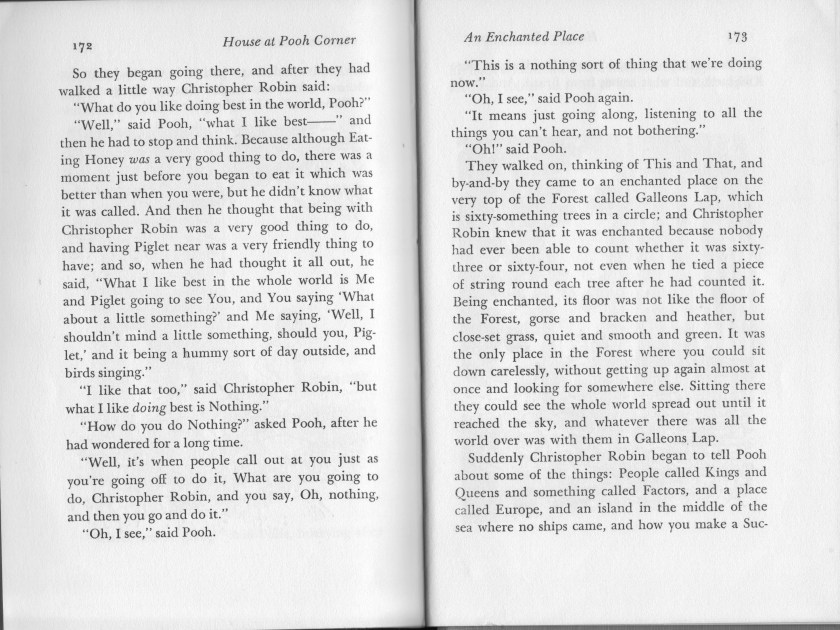
Winnie-the-Pooh On Nothing (from The House at Pooh Corner, with thanks to Louise Dubreuil)

As part of the Mile End Poets’ Festival, I’ll be giving a Short Presentation About Nothing. A kind of performative lecture bringing together bits & pieces of readings, reflections, actions (and non-actions) that all point to the very paradoxical and ever-so-stimulating notion of Doing Nothing. I’ll also be sharing the stage with two of Montreal’s finest poet/performers, Kaie Kellough and Tanya Evanson, along with musical act Skin Tone.

Where: Casa del popolo, 4873 St-Laurent
When: April 4, 2017; doors open at 8pm, show starts at 9pm
How much: $7

– read more about the festival here –

Post-Talk Thoughts: Curtis & Carly on Doing Nothing

A small group of keeners braved the snow storm this past March 15 to come out and partake in the informal conversation being led by Curtis Murphy and Carly Gaylor, two young Unitarian ministers who will soon be starting their own “slow ministry” in Hamilton Ontario.

As the third in the series of Talking About Nothing With… this was Curtis and Carly’s first time “giving ministry” (as it were) as a duo, taking the opportunity to test the waters as a couple. (What can I say, I am so honoured!)

And so, a short presentation by Carly and then by Curtis was followed by an animated conversation over tea and homemade banana bread – excellent items to be consuming in a storm.

Here below, a smattering of some of the bite-sized reflections that were shared…

First off, before we even got there, I was at my partner’s place during which time he was teasing me for not cancelling the talk. “Everything is closed today because of the snow, even McGill University! And you’re still having your talk?! You are so determined.” To which I replied, “Yeah… it’s because it’s in the evening and it’s inside (unlike most of my other gatherings, which are more weather-sensitive because of taking place outdoors). People will have had time to shovel, and we’ll be cozy in the DARE-DARE trailer.”

Then, as if on cue, Curtis appeared (he and Carly are temporarily my partner’s roommates while Curtis finishes up seminary school) and he says: “Well, everyone has something to do, so all their somethings are cancelled. But have nothing to do. So there’s nothing to cancel.”

…BOOM!

More quotes from Curtis:

“This whole ‘work/life balance’ idea needs to be revisited; it assumes that work is separate from life…We’re starting from a terrible place if work is not a part of life.”

“We’re experimenting with a Digital Sabbath; how it is we make less screen time in our downtime. It started when I asked myself, ‘What’s the thing that I default to which is taking me away from what I really want to do?’ When you take away the default mode (in my case and for many people, reverting to a computer or tablet, or phone) it leaves room for something else. So at first when I began limiting my internet use I had lots of anxiety. But then that eventually gave way to huge space – to more time…!”

“Often we’re struggling against the currents in our own lives, of everything circulating around us, in order to do nothing, or less, or slow…”

And Carly shared an anecdote which for her represented a definitive moment in her desire to want to initiate a “slow ministry.” She described having been called in to do supplemental work for a church out west, and how all the members of the parish were working like fiends. They took on tons of projects, in an effort to stay contemporary and bring in more members, but the end result in the community around her was stress and burnout. At one point during her tenure there Carly realized that this is exactly the kind of operation she did not want to be part of. From there on she began to let go of more and more responsibilities, preferring instead to do less, but do things with greater calm and presence.

“Taking on more and more and more just causes more anxiety. So I had a revelation, a rule of thumb that became my ‘ministry to myself’: I like slower…”

The question of “freedom” in connection to the “right to choose rest” came up, but how this sense of freedom can in fact end up undermining our freedom – a kind of “Capitalism as Freedom” whereby, like in the realm of capitalism (and our unspoken obligation to be a part of this system), “We’re forced to be free.”

This lead to a brief discussion on the question of “limitations” and whether limits are necessary, I.e: deciding to do less, to stop working, to make space for unproductive time. “How do we institute limitations and it not feel like punishment?”, One person asked.

…Or shame. We came back to that (very prescient and ubiquitous) idea of how doing less or doing little is often equated with a lack: of strength, of discipline, of morality. How we are trained from a very young age to go into the world as productive beings as this is also a proof of (good) health.

…So the new ministry, as Curtis and Carly described, is definitely trying to “think outside the box,” wishing to address all these issues and more, looking toward “Doing Nothing” as a communal act.

…As Curtis aptly put it: “…I feel as though I am reclaiming time as a spiritual quest.”

Doing Nothing, Micronesian Style

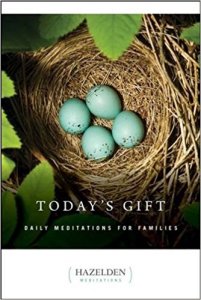
The following reflection comes from a book called Today’s Gift: Daily Meditations for Families in which an inspirational quote is followed by a brief explanation as applied to daily life. This one about Doing Nothing appears in the July 4 entry (with thanks to Pohanna Pyne-Feinberg, for sending it my way!):

“In Micronesian, there’s a word, kukaro, which has no corresponding word in English. When people say they are going to kukaro, they mean they are going to relax, sit around, and hang out. They are being, not doing.” –Eli and Beth Halpern

As children, our best times are often trips to an amusement park, fishing at the lake, camping, or just sitting idly under a tree. These make the best memories, and times sitting around a campfire roasting marshmallows or having a root beer after a family outing seem to bring out the love we share.

We don’t seem to be accomplishing anything at these times. No chores are getting done around the house, no schoolwork, no repairs, and no moneymaking.

But these times of peace, relaxation, and a sense of endless time of being, not doing, may be essential to our ability to get other things done later. Certainly we are most receptive to our feelings, new ideas, and unplanned adventures at these moments. Maybe we should add kukaro to our vocabulary.

Allen Ginsberg on Doing Nothing (1974)

A re-posting of Vince Tinguely’s, who brought this wonderful quote to my attention:

I’m interested in meditation, in exploring inner space, in a certain political movement which would involve a sit-in in Washington where hundreds of thousands of people would just go to Washington and sit down. Ten hours on Monday, for ten days, ten hours a day, doing nothing but sitting. I’d like to see that. That many people doing nothing would create such a pool of nothing-doing that it just wouldn’t contribute to the aggression that’s going around. I’d like to see Nixon sit down and do nothing for a while and take a rest, stop working so hard.

– Allen Ginsberg, from ‘A Conversation’ in Composed On The Tongue, August 8, 1974

Talking About Nothing With… Parlons de rien avec… Carly Gaylor & Curtis Murphy (Hamilton)

Public Forum About Nothing Presents: Talking About Nothing With…

Curtis Murphy & Carly Gaylor
March 15, 2017 from 5 to 6:30pm
DARE-DARE trailer
Intersection Atwater, Greene & Doré in front of the Atwater market

As part of the yearlong project, The Sanctimonious Sect of Nothing Is Sacred, I am inviting artists, researchers, thinkers, and practitioners of various disciplines – both within and outside of the arts – to present their reflections in an open format around the question of Doing Nothing.

The third in the series is a presentation, followed by an open discussion, with Hamilton-based Unitarian ministers Carly Gaylor and Curtis Murphy.

Carly and Curtis are currently exploring slowing down as a spiritual practice, making Sabbath a regular part of their lives, and are preparing to start a (slow) new ministry in Hamilton where they will practice doing money differently and having an answer to “how are you?” that is not “busy.” They’ll share experiences and ideas about Sabbath and taking things slow.

Presenters’ bio
Curtis is currently finishing his final year of seminary to become a Unitarian Universalist minister, and Carly was ordained in the same tradition in 2013. They enjoy yoga and meditation, subversive economics, tossing a frisbee, eating at the local all-day breakfast joint, and Star Trek.

**

Dans le cadre du projet L’édifiante secte de rien (n)’est sacré, qui se déroule sur un an, j’invite des artistes, chercheur.es et praticien.nes issu.es de diverses disciplines [artistiques ou extra-artistiques] à présenter leur réflexions durant une série de discussions informelles portant sur la question du rien faire. La formule est complètement ouverte, ce qui permet à chaque conférencier.ère de prévoir la manière dans laquelle il ou elle désire aborder le sujet et engager l’auditoire.

Le troisième rendez-vous de la série est une présentation, suivie d’une discussion ouverte, avec Carly Gaylor et Curtis Murphy, pasteurs de l’église unitarienne (Hamilton, Ontario).

Carly et Curtis explorent l’idée de ralentir comme une pratique spirituelle. En insérant le Sabbat de manière plus régulière dans leur quotidien, ils travaillent à mettre sur pied une nouvelle congrégation à Hamilton (ON), où ils souhaitent repenser le travail et essayer de trouver une autre réponse qu’«occupés» à la question : «Comment allez-vous» ? Dans le cadre de cette causerie, ils partageront leur expérience et réflexion autour du Sabbat et la notion de prendre la vie sans stress.

Bio des conférencier•ère•s
Curtis en est à sa dernière année de séminaire pour devenir un pasteur de l’église Unitarienne Universelle. Carly a été ordonnée dans la même confession en 2013. Ils aiment le yoga et la méditation, les économies subversives, jouer au frisbee, manger au resto-déjeuner du coin et regarder Star Trek.

Doing Nothing in Le Devoir

I mentioned this article in the previous post but for those who want a fast peek (and to not have to dig around to find it): … a very thoughtful piece written by Jérôme Delgado making parallels between my project and an installation in Quebec City by an Italian collective on the importance of slowing down.

http://www.ledevoir.com/culture/actualites-culturelles/492496/ne-rien-faire-a-l-affiche