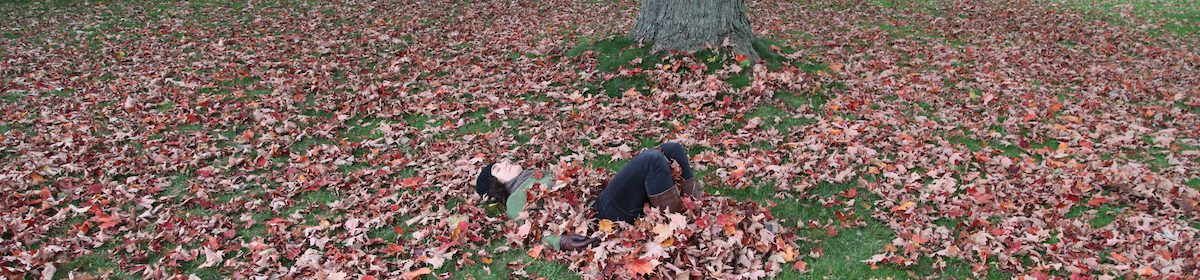
CBC radio’s Daybreak was curious to hear about my Summer Slacking. As a result I had a nice little chat with host Mike Finnerty about the virtues and complexities of collectively Doing Nothing – all in 4 minutes! You can listen to that interview here:
Author: Victoria Stanton
Montreal-based performance artist, writer, and educator Victoria Stanton explores live action, human interaction, video, film, photography, and drawing.
How To Stop Time

OK, first off, the weather was impeccable. And the possibility to take this time and just chill was lovely. But extremely challenging nonetheless! See, the idea of resting at the dock was basically an extension of my daily walk. And the thing about the daily walk is that it’s very rare I actually sit for longer than five minutes. So believe it or not, this 2 x slacking (which turned into 3, I went back again on the “rain date”) was hard to do! Not only because it was incredibly busy with tons of other slackers (people swimming, fishing, boating, listening to music, drinking beers and being generally rowdy) but because it came right at the time when I have finally started to enter back into my regular routine (i.e: sitting at my computer for several hours a day). So for sure… being in this beautiful setting, I was also feeling the pull to have to “get back to work.”
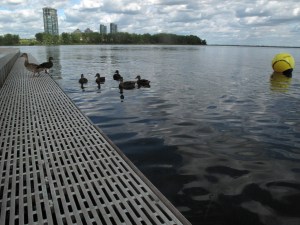
…It’s one of the reasons why I decided to stay for a full two hours each time. Because it took several minutes just to arrive, then several more to let myself commit to really being here. That kind of unwinding process that happens when you do finally stop. And the time it takes for your mind and body to eventually catch up too…

2 x Nothing: Summer Slacking on the Dock

So I’m back on my feet and summer is not over yet!
And because I haven’t had my full fix of quiet times by the water
I plan to hang out on the dock and do nothing.
Feel free to join me:
When: Aug. 24 and Aug. 29 at 3pm
(the second date will be on Aug. 30, if rain).
Come just the one time or both, as you like***
Where: on the dock on the river in Verdun. Which one? If coming off of LaSalle boul. It’s between Richard and Brault streets (Verdun metro)
***2 options: Come meet us by the water (at 3pm)
or come accompany me on my daily walk.
If the latter, let’s meet at 2:20pm at de l’Église metro, Wellington exit, upstairs outside (corner Wellington and Galt)
*
Pour célébrer
la fin de l’été
Avant la rentrée
Rendons-nous au quai!
Pour quoi faire? Pour rien faire!
Rassemblons-nous pour se reposer ensemble…
Quand : le 24 août à 15h et le 29 août à 15h
(ce dernier remis au 30 août, en cas de pluie).
Venez une fois ou les deux, à votre goût***
Où : le quai sur le fleuve à Verdun. En descendant de boul. LaSalle, ce sera entre rue Richard et rue Brault (métro Verdun)
***2 options : Venez nous rencontrer sur le quai (15h)
ou bien, marchez avec moi sur mon parcours quotidien. RDV à 14h20 métro de l’Église, sortie Wellington, sur la rue (coin Wellington et Galt)
Talking Head’s Take On Nothing
A clip of my all-time favourite group, from my all-time favourite concert film, Stop Making Sense. I especially love how, in the middle of the song, the camera shifts focus to stagehands preparing for the next number: the beautiful banality of the background, of the something we’re usually not supposed to notice, suddenly brought forward, while we contemplate the band’s poignant take on Nothing…
“Everyone is trying
To get to the bar
The name of the bar
The bar is called heaven
The band in heaven
They play my favorite song
Play it one more time
Play it all night long
Heaven
Heaven is a place
A place where nothing
Nothing ever happens
Heaven
Heaven is a place
A place where nothing
Nothing ever happens
There is a party
Everyone is there
Everyone will leave
At exactly the same time
It’s hard to imagine that
Nothing at all
Could be so exciting
Could be this much fun
Heaven
Heaven is a place
A place where nothing
Nothing ever happens
Heaven
Heaven is a place
A place where nothing
Nothing ever happens
When this kiss is over
It will start again
It will not be any different
It will be exactly the same
It’s hard to imagine
That nothing at all
Could be so exciting
Could be this much fun
Heaven
Heaven is a place
A place where nothing
Nothing ever happens
Heaven
Heaven is a place
A place where nothing
Nothing ever happens”
Written by David Byrne, Jerry Harrison • © Warner/Chappell Music, Inc
How Walking and Doing Nothing Intersect

Following yesterday’s missive I also wanted to mention that I finally started Rebecca Solnit’s book, Wanderlust. It’s one of those titles that’s been on my shelf for ages and an obvious one to have procured given my interest in walking as a “post-studio” (i.e. non-material yet creative/generative) performative practice. For some reason I never got to it before now, though. And I’m really grateful that I waited. Had I read it prior to this project I may have missed this beautiful overlap – a gently revolutionary Solnit-ian gem:
“[T]hinking is generally thought of as doing nothing in a production-oriented culture, and doing nothing is hard to do. It’s best done by disguising it as doing something, and the something closest to doing nothing is walking.”
‘Nuff said.
The Link Between Doing Nothing and Depression (aka What I learned On My Summer Vacation)

One of the (many) reasons why this project of Doing Nothing is so daunting to me is in fact beyond my perceived obligation of adhering to an insidious set of principles I have unwittingly ascribed to for much of my “productive” life – namely the “Protestant Work Ethic.” (I’m not even Protestant). It’s not just about the “feeling-guilty-because-I’m-not-working-enough” factor. The guilt surfaces, but then eventually subsides. No, it’s something more debilitating than that. An irresistible cycle of other sensations is activated – feeling ungrounded, unsettled, confused – which is then capped off by the kicker: I become depressed. And the longer the time I have to disconnect from the rest of the world (i.e: my computer) the more likely that inevitable depression descends upon me. I’ve previously considered the connection between being (or rather keeping) busy and holding myself together. And this is a known phenomenon too, I realize I’m probably not telling you something you don’t already know. But having the month to sit with this, and let it sit with me, was not the easiest. Once my body’s healing process was underway, I had lots of time to be… with myself, my thoughts and my anxieties. Not being able to really take walks, or do much in the way of physical exertion; not being able to read anything too dense; not really having the concentration to sit and write… meant I had a lot of time to think. Or not think. To just blank out. And feel sad.
Admittedly there were moments of bliss. How joyful to be quiet and calm. To not be on a schedule. To not have to produce! But it often felt tenuous. That adolescent existential stuff that I recall so vividly, those annoying questions that plagued me, seemed to resurface: “What’s the point? What’s my purpose? Is that all there is?” And as one day started melting into another…each day feeling exactly the same, filled with… nothing (I have a history of depression which began at around the age of 14 while reading Albert Camus no less)… I was just concerned that it might spiral out and I along with it…
Which I didn’t. I credit my chanting meditation practice for keeping me on track. But even that felt tenuous at times too. In the realm of Depression, Lethargy is only ever a few steps away…
One book I did manage to read – as recommended to me by fellow artists from DARE-DARE – had some insightful reflections on the connection between spacing out and being down. According to Andrew Smart, a human factors research scientist, apparently when we engage in idleness, all kinds of deeper recesses in the brain light up: “This ‘resting-state network’ (RSN) or ‘default-mode network (DMN),’ as it is called … comes alive when we are not doing anything.” (Autopilot, p.19).
Because these areas of the brain are concerned with memory and the unconscious – where the things we would rather not encounter generally stay buried:
“What comes into your consciousness when you are idle can often be reports from the depths of your unconscious self – and this information may not always be pleasant. Nonetheless, your brain is likely bringing it to your attention for a good reason.” (Autopilot, p. 3).
So I think he’s on to something when he asserts (from the same page above):
“Psychological research has shown that humans, especially American humans, tend to dread idleness. … Given the slightest or even specious reason to do something, people will become busy. People with too much time on their hands tend to become unhappy or bored. Yet … being idle may be the only real path toward self-knowledge.”
After Nothing, Then What?

Today, August 8, I am officially “back to work.” Be it that I work from home and that it’s still summer season for the cultural sector I don’t have a ton of stuff to get back to (for which I am really grateful). But I feel the quiet rumblings of a busy fall soon upon me.
I know I wrote in my previous post that I would take the two weeks for convalescence and then follow that by just taking time off. That timeline came from the hospital who claimed that most people go back to work after two weeks. Um… good thing I didn’t have a job to go back to because almost five weeks later and I’m still not functioning at full speed. Yes, I can do the normal things we (modern) humans do: answer an email, make a salad, do an errand, have a conversation, take a walk (albeit, still a fairly short one) but my concentration is pretty limited and my brain is doing funny things. And my body… is still feeling the strange pulling and re-settling sensations that I guess come from things having been poked around in there (and removed). I hear the anesthetic can take a while to fully leave your system too.
So that got me thinking about the pressure we are so often under to be on it. All the time. To bounce back. And in no time at all. It’s taking me way more time than that. I’m just really glad I have that time to take.
Operation Healing (aka Doing Nothing This July)

This July 5, 2016 I will be undergoing laparoscopic surgery. It means that I’ll be forced to do nothing for one to two weeks afterward to allow for convalescence. Doing a lot of nothing while my body does a lot of something: healing itself. It got me thinking: what if I take the two weeks and turn it into a whole month? As in, take the month of July off. As in, vacation responder on my email account and check out from Facebook. As in, stop working. (The prospect simultaneously thrills and terrifies me).
But it’s decided. I am taking that time to heal. And have a break.
Good timing, what with this Nothing project going on and all.
The reason why I am sharing this with you is because I have a proposition:
While I spend the month healing from this operation I invite you to take an hour (or several) once a week (or every day) to sit with something that you feel you would like to heal too (physical, emotional, etc.). Reflect on it, write, sing, dance, draw, walk, swim, meditate… or just hold it lightly as a gentle intention and space out. Any formula you wish; as often or as infrequently as suits your needs; it’s yours and your rules to play with.
You could also just take that hour and do nothing.
What are you wishing to start – or continue – healing from this month?
More Links to Nothing
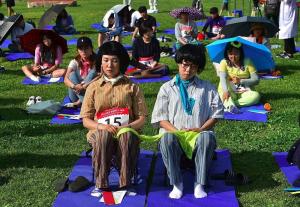
This one kinda went viral but I can’t resist (re)posting it here (it was sent to me by several friends/colleagues after I announced the Space-Out Solstice. Funny coincidence of timing!) :
• Doing Nothing Has Become a Sport in South Korea
“A few weeks ago, on a Sunday afternoon, about 70 people gathered at Ichon Hangang Park in Seoul, South Korea, to do absolutely nothing. There was not a smartphone in sight, no texting or taking selfies, and no one rushing to get anywhere.
The crowd was taking part in South Korea’s annual Space Out Competition, a contest to see who can stare off into space the longest without losing focus. WoopsYang, the visual artist who created the event in 2014, said it’s designed to highlight how much people have been overworking their brains and how much they stand to gain by taking a break…”
• Slow Dance as an Act of Resistance
“The agitated pace of capitalism creates a tonic state of dis-ease and dis-connec- tion felt in the (more-than-human) body and, as a result, a pathology of place imprints itself onto/into bodies as a re-enactment or performance of a dis-eased environment (or place). How can we return new life to our dulled senses? What are the pathways to reconnect? As an exploration of an embodied cellular understanding of place/loss of place through (eco)somatic practices, slow knowledge, and relational embodied ethics, this paper/presentation will speak to/with/through a site-responsive, performance-based research project in progress by Sally Morgan…”
Solstice Magic


And so: the workshop (Boundaries of the Body) wrapped up on Monday eve, with a blissed-out kinda vibe and a real desire to, once again, not make anything (see post-apple blossoms below). There was a thought that we could do an action (or non-action) but what we really wanted was to just hang out. And eat. Plus our timing was such that an activity was already going on right next to us (monthly public dance event at Beaver Lake). And so: a spontaneous picnic on the concrete in front of the space-age ice-skating chalet unfolded beside the folk-dance gathering before a rainstorm then followed by an epic twilight walk with a surprise glimpse of an incredible strawberry moon.
It was pretty close to perfect.
And so: apologies if you came out and didn’t find us! I hope in that case you found/made/felt your own brand of special solstice magic! You were definitely with us in spirit!
 The Sanctimonious Sect of Nothing Is Sacred